
29-Jun-2026

5 Min Read

Ashok Paul
India's opportunity in genomics is significant — but the ecosystem is still evolving.
Across oncology, rare diseases, fertility care, inherited disorders, neonatal and pediatric conditions, cardiology, metabolic diseases, pharmacogenomics, transplant care, preventive health, and even performance medicine, genomic testing is gaining visibility. Adoption is increasing in metropolitan healthcare systems, and Tier-2 cities are gradually beginning to explore its relevance.
But despite this momentum, the current ecosystem remains fragmented. In many settings, genomic testing is still conducted as an isolated activity. A sample is collected, sequencing is performed, a report is generated, and the output is handed over to a clinician or patient. What happens after that is often inconsistent.
This is where the real challenge begins. The question is no longer only: Does India need more genomic testing? It does. But the more important question is: How do we make genomics scalable, affordable, sustainable, and clinically relevant for India? Because the future of genomics will not be defined merely by the number of tests performed. It will be defined by how effectively genomic insights can support better healthcare decisions.
Genomics is becoming a decision-making layer
Genomic testing should not be viewed only as a diagnostic service. It is becoming a decision-making layer in healthcare. Its value lies in helping answer clinical questions such as:
- Which treatment is more appropriate?
- Which toxicity may be avoided?
- Which newborn may need early intervention?
- Which couple may need reproductive guidance?
- Which family member may benefit from screening?
- Which preventive action can begin earlier?
This is the real shift India must focus on — from genomic testing to genomic decision-making.
A genomic report should not stop at listing variants. It should explain what matters, why it matters, what the evidence says, and what could be considered next. That is where genomic data becomes clinically useful.
The opportunity is broader than one specialty
In India, genomics is often discussed mainly in relation to oncology or rare diseases. Both are important and high-impact areas. But the future opportunity is much wider. Genomic intelligence can support cancer care, inherited disorders, infertility, recurrent pregnancy loss, neonatal screening, pediatric genetic conditions, inherited cardiac disorders, metabolic disorders, neurological diseases, transplant care, pharmacogenomics, preventive health, longevity, nutrition, recovery, fitness, and sports performance.
Each area has a different clinical purpose.
- In oncology, genomics may help identify actionable biomarkers, resistance patterns, hereditary risk, or trial relevance.
- In reproductive health, it may support carrier screening, recurrent pregnancy loss evaluation, or informed family planning.
- In newborn and pediatric care, genomics may help identify serious conditions early enough to change outcomes.
- In inherited cardiac or neurological disorders, it may support family screening, risk stratification, and long-term care planning.
- In pharmacogenomics, it may help physicians understand drug response, metabolism, toxicity risk, and dose sensitivity.
The common thread across all these use cases is not sequencing alone. It is interpretation. Without interpretation, genomic testing remains technical. With interpretation, it becomes clinical intelligence.
Testing alone will not create population-scale impact
India cannot build a genomics future by increasing testing capacity alone. Testing is necessary, but not sufficient. A country can generate large volumes of genomic data and still struggle to create meaningful clinical impact if the ecosystem is not connected. A genomic test may be ordered, but the clinician may not receive a clear, usable interpretation. A variant may be reported, but the patient may not receive counselling. A clinically relevant finding may be identified, but there may be no structured follow-up pathway. A report may mention actionability, but drug access, affordability, or clinical relevance may remain unclear.
This is why genomics must be designed as part of a care pathway, not as a standalone report. The real impact comes when testing, interpretation, counselling, clinical decision-making, follow-up, and evidence updates work together.
India needs an integrated genomics ecosystem
To make genomics scalable and meaningful, India needs a connected ecosystem. This ecosystem must bring together hospitals, clinicians, diagnostic laboratories, genomic laboratories, genomic intelligence platforms, genetic counsellors, bioinformaticians, clinical scientists, academic medical centers, research institutions, pharma and biotech companies, insurers, public health programs, patient advocacy groups, regulators, and policymakers.
Each stakeholder plays a different role.
- Labs generate data.
- Clinicians apply insights to patient care.
- Genetic counsellors help patients and families understand implications responsibly.
- Bioinformaticians and genomic scientists ensure analytical and interpretation quality.
- Technology platforms convert raw genomic outputs into structured, evidence-linked, physician-readable reports.
- Research institutions help strengthen Indian genomic evidence and population-specific understanding.
- Policy makers and regulators create the standards needed for privacy, ethics, access, quality, and responsible use.
No single stakeholder can build India’s genomics future alone. The real opportunity lies in coordination.
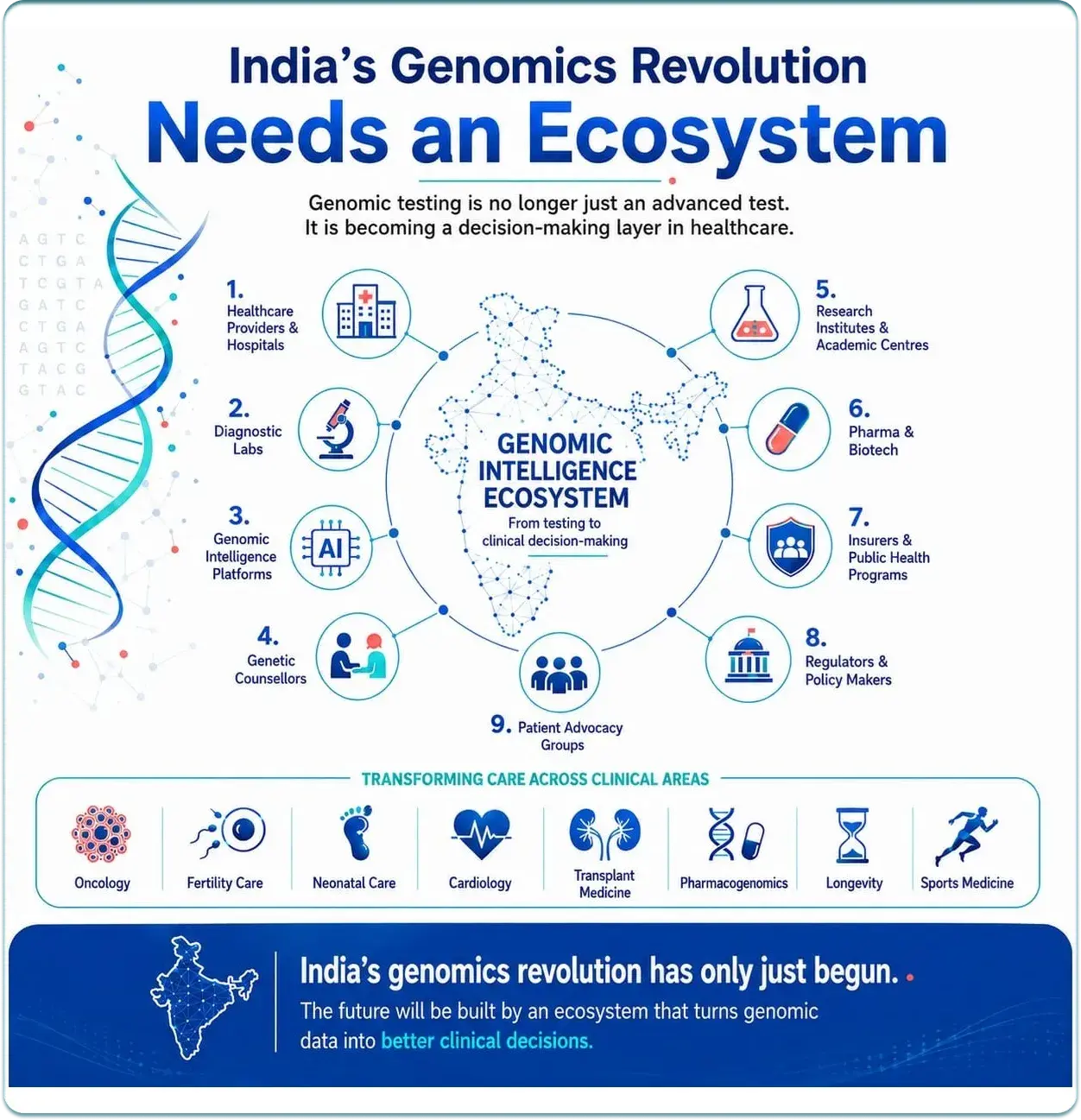
Figure 1. India's Genomic Intelligence Ecosystem – A connected ecosystem linking healthcare providers, diagnostic labs, AI-powered genomic intelligence platforms, researchers, pharma, insurers, regulators, and patient advocacy groups to transform genomic data into clinical decision-making.
Reports must become clinically useful
One of the most important gaps in genomics is report usability. A technically detailed genomic report is not always a clinically useful report. Clinicians work under time pressure. Patients face real-world constraints such as affordability, access, geography, and follow-up challenges. In this environment, genomic reports must be clear, structured, and decision-ready.
A useful report should connect:
- Variants to clinical context
- Evidence to treatment relevance
- Risk to family implications
- Drug response to toxicity considerations
- Uncertainty to responsible interpretation
It should help the clinician understand what is important without forcing them to navigate pages of technical data. This is where genomic intelligence platforms can make a meaningful difference. They can help laboratories and healthcare organizations move from raw genomic data to clinically usable insight by bringing together bioinformatics workflows, curated evidence, interpretation frameworks, and physician-friendly reporting.
The goal is not to replace expert review. The goal is to make expert interpretation more scalable, consistent, and accessible.
The Indian model must be built for Indian realities
India cannot simply copy genomic models from the West. Our healthcare system has its own realities. We have a large and genetically diverse population. Access varies widely between metros, Tier-2 cities, and rural regions. Cost sensitivity is high. Genetic counselling capacity is limited. Many global genomic databases still underrepresent Indian population diversity. Clinician awareness is improving, but adoption remains uneven.
These are challenges, but they are also opportunities. India can build a genomics model that is not only scientifically strong, but also scalable, affordable, and context-aware. The goal should not be genomics only for elite hospitals or premium patient groups. The goal should be genomic intelligence that can support a wider healthcare network — from advanced cancer centers to regional hospitals, from diagnostic labs to preventive health programs.
For that to happen, genomics must become easier to interpret, easier to integrate, and easier to act upon.
From sequencing capacity to decision infrastructure
The next phase of India's genomics journey will not be defined only by who can sequence more samples. It will be defined by who can make genomics more useful.
- More useful for clinicians.
- More understandable for patients.
- More scalable for laboratories.
- More affordable for healthcare systems.
- More actionable for treatment, prevention, and family care.
India needs more genomic testing, but more importantly, it needs genomic testing that leads to better healthcare decisions. The real genomics revolution will not be driven by tests alone. It will be driven by an ecosystem that transforms genomic data into clinically meaningful, accessible, and actionable intelligence at scale.